
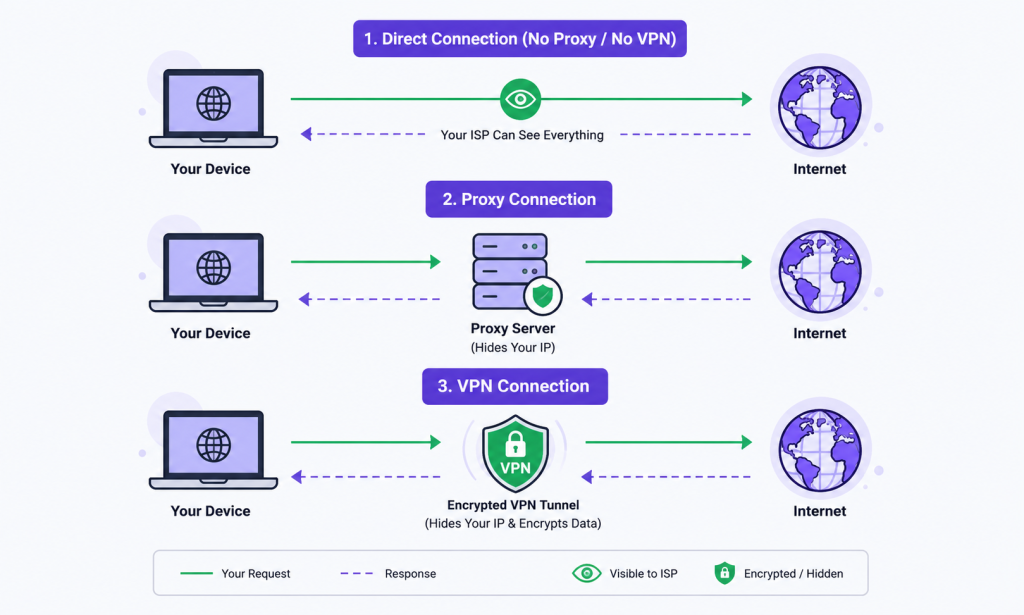
Though proxies and VPNs both provide privacy, they do it differently. The difference between proxy vs. VPN capabilities is that the proxy only serves as a gateway between the internet and users. On the other hand, VPN traffic runs through an encrypted tunnel and the user’s device, making VPNs an effective solution for ensuring network security.
What is proxy server?
A proxy server serves as a gateway between the Internet and the users. It is also called an intermediary server because it sits between the end-user and all of the web pages that they access. The Internet Protocol (IP) address of a Proxy vs VPN server is also different from the one assigned to the client computer, and Internet activity seems to originate from another location. It’s configured as firewalls or web filters and can defend your devices against cyber attacks.
This intermediate function may occur in enterprise environments, and is sometimes strengthened by the use of proxy server firewall systems—which include both traffic filtering and access control policies.
There are several different types of proxies:
Forward proxy
A forward proxy is used as a means of accessing data from a group of users in an internal network located in front of the clients. As the request is sent, the proxy server will look at it and determine if it should make a connection.
Forward proxy is the most appropriate for an internal network with a single point of entry. It offers security for IP addresses for those within the network and enables easy administrative control. However, there could be restrictions on the organization’s capacity to serve the needs of the end-user.
Transparent proxy
A transparent proxy can provide users with the same experience as if they were using their own computer. This way, it’s “transparent.” They also can be “forced” on users and connected without their knowledge.
Businesses that wish to leverage a proxy without their employees realizing they are using a proxy would be suitable for use of a transparent proxy. It has the benefit of having a smoother user experience. Transparent proxies, however, are more vulnerable to some security attacks like SYN-flood denial of service attacks.
Anonymous proxy
An anonymous proxy is geared towards internet activity being not traceable. It functions by browsing the web on behalf of the individual without revealing his/her identity, or computer information.
Transparent proxy will be appropriate for users who wish to be anonymous when using the Internet. Transparent proxies offer some of the greatest levels of protection of an identity, but they aren’t perfect. What is a proxy vs vpn Many consider using transparent proxies to be shady and sometimes may be subject to rejection or discrimination.
High anonymity proxy
High anonymity proxy is an anonymous proxy, with one step more. It does so by wiping out your information before the proxy tries to connect to the target site.
A high anonymity proxy server is ideal for those users who need anonymity more than anything else, including employees who don’t want their actions traced back to their company. The disadvantages include some of them, especially free ones, as decoys to obtain the personal information, or data of the users.
Distorting proxy
A distorting proxy pretends to be a proxy to a website, but disguises itself as a proxy. It does this by altering its IP address to a wrong one.
Distortion proxies are suitable for individuals who want to conceal their identity when they’re on the internet. This sort of proxy can make you seem like you’re surfing from a specific nation and provides you the benefit of remaining anonymous not only as you but as the proxy as well. This means that even you as a proxy are safe.
But certain websites are pre-programmed to reject distorting proxies that may hinder an end-user’s ability to access sites that they require.
Data center proxy
Data center proxies are not connected to any Internet service provider (ISP), just another company that offers them to you from its data center. The proxy server is physically located in the data center, and the user’s request goes through the proxy server.
For those who require speedy connection and a more affordable solution, data center proxies are a great option. For this reason, they make good use for those who have to acquire information about someone or something in a short period of time. They have the added advantage of providing users with the ability to easily and cheaply extract data. However, they aren’t as secure as they can be in terms of anonymity, and this could compromise the user’s information or identity.
Residential proxy
A home proxy delivers an IP address located with a certain physical device. From there, all requests are funneled through this device.
If you want to confirm the ads that appear on your website, residential proxies are a great choice; you can prevent ads from bad actors or competitors from appearing on your website. Residential proxies are more reliable than other types of proxies. They are, however, more expensive to use and consumers must determine if they are worth the additional expense.
Public proxy
Public proxy – freely accessible by everyone. It does so by providing users with access to its IP address and concealing their identity when they visit web pages.
For users who worry primarily about cost, public proxies are the best option available, as they do not require security and speed are not as crucial. They are free and readily available, but are slow due to free users. You will have a higher chance of your data being accessed by others on the internet when you are using a public proxy.
Shared proxy
More than one user uses shared proxies at a time. They provide you with an IP address that could belong to others; then you can surf the web as if you were located in a specific area.
If you do not have a lot of cash to burn, and aren’t really looking for the fastest connection, shared proxies are a good choice. The greatest benefit of using a shared proxy is that they are very cheap. They are also part of other people’s bad decisions, so you may be held responsible for them and get banned from a site if it’s inappropriate.
SSL proxy
A secure sockets layer (SSL) proxy is a proxy that offers decryption between the client and the server. The data is encrypted on the way both ways, and the proxy is inconspicuous to both client and server.
For organisations that require greater protection from threats the SSL protocol reveals and blocks, these proxies are the best suited. An SSL proxy, when used with a website, can help improve the ranking of the website’s search engine on Google as Google favors servers that use SSL. The downside is that, content encrypted on SSL proxy cannot be cached, and if you visit sites several times, you may have to wait longer to get the same service.
What is a VPN?
A VPN works a lot like a proxy server, except that it routes Internet traffic through a different IP address. However, with VPNs, traffic runs through an encrypted tunnel between the remote VPN network and the user’s computer or device, making VPNs an effective solution for ensuring network security.
These solutions can be used by businesses to secure employee connections on distributed networks, known as enterprise VPN solutions.
When users access the internet from a public place such as a coffee shop, a reliable VPN provider will provide users with a safe way to do so, particularly when using a public Wi-Fi network. Users can be able to connect to a VPN as opposed to a local Wi-Fi network, which, with no encryption or weak security, can expose exclusive data to others.
There are various types of VPNs like remote access VPN, extranet based site-to-site VPN and intranet based site-to-site VPN.
Corporate VPN
Corporate VPNs are used by businesses to protect users and their devices, regardless of where employees connect to these devices.
Individual VPN
These are services that are meant for individual use.
Proxy vs VPN
On the surface, VPNs and proxy servers may seem similar, but there are key differences to be aware of. In choosing between a proxy server vs. VPN, companies should think about:
Security
While proxy servers can prevent websites from tracking your identity, they are not responsible for encryption. A public proxy server connection is not as secure as a connection made to a web server via a browser. VPNs are a secure solution, as they encrypt data before dispatching it to the client, concealing your identity from the web and your ISP along the way.
Privacy
While both a VPN and a proxy server will hide the user’s IP address, they handle data in different ways. A proxy server acts as a “middleman” between a user and the Web. They hide the user’s IP address from a web server the user visits, but it does not secure the data that is sent and received.
A VPN takes this process a step further. It conceals your IP and location information, which means that you are not identifiable. Meanwhile, it implements end-to-end encryption, meaning that an ISP or router can’t access the user’s data, giving it complete privacy for the user. Also, if the data is encrypted and is intercepted, bad guys will have nothing if they are unable to decrypt it.
Speed
A proxy is a single server that could be accessed by multiple users simultaneously. This can result in delays in connection speed. A free proxy connection can prove even slower. VPN servers that are further away from the user can also lead to slower connection speeds. But, when the VPN service provider has the right technology and maintenance procedures, the delays will be too insignificant to be noticed.
Fortinet products & services
While VPN is a vital component of a robust defense against leaks, it is not sufficient to ensure that sensitive information is protected and your organization’s network is secure in today’s fast-changing cybersecurity landscape. Users require seamless and secure access to applications from the cloud, data center and SaaS platforms, whether in the office, home or on the go.
Fortinet protects and enables organizations to connect to critical applications and resources while allowing their work-from-anywhere employees and devices to operate securely. Fortinet Universal ZTNA is a powerful security solution that provides businesses with flexibility, granular access control and continuous verification. It enables policies to be enforced for users regardless of location. With granular access control, access is granted to specific applications only for that session, providing better security.
The client-initiated model offers greater transparency and control for the IT team, and gives the users a better experience. Since Universal ZTNA does not need additional licenses and is a free feature in FortiOS and FortiClient, customers can move from VPN to ZTNA at their own speed. Fortinet’s flexibility allows you to not have to opt for one or the other: VPN or ZTNA, you can build the solution that works best for you.
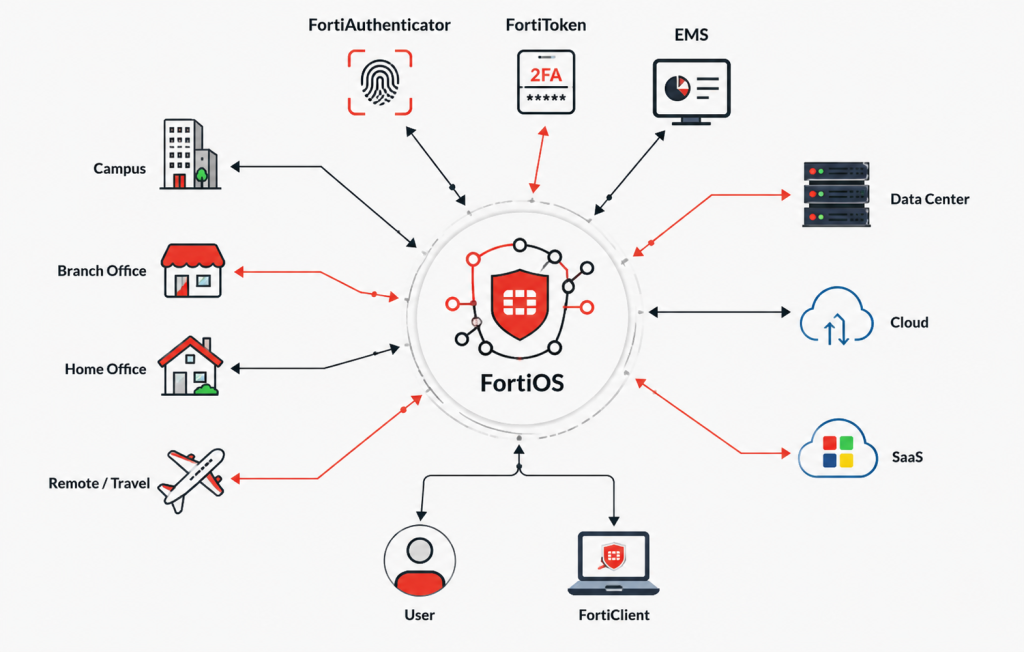
In the age of constant shifts between on-premises, home network and public network environments, endpoint, network and zero trust security must be brought together under a single security management and control center.
A consistent user experience is seamlessly delivered with a set of APIs and integration points, allowing users to easily move between locations and while traveling there, enjoying a consistent user experience with the right level of contextual security. Fortinet is the only vendor with the ability to provide the unified approach, so that users can enjoy proactive, integrated and context-aware security automatically adapting to their location, device, and resources.
Fortinet’s broad range of security, services and threat intelligence solutions across the Fortinet Security Fabric can automatically follow users across distributed networks. The Security Fabric can also adapt the level of enforcement based on the perceived threat of each interaction, on the road, at home or in the office, allowing for enterprise-level protection across the entire end-to-end experience and boosting productivity.
Proxy servers vs VPNs FAQs
VPN vs. proxy?
On the surface, there is a similarity between proxy servers and VPNs. So, which one should your business use – VPN or Proxy?
VPN is more secure since its traffic is encrypted. It’s the perfect solution for organizations that must safeguard their browsing activity or that have sensitive information to protect.
A proxy server may be useful to organizations that just need to have users log on to the Internet anonymously. This also allows them to track the type of sites their workers are using and can ensure that their workers have access to websites that may be blocked in their country.
The use of a proxy server along with VPN?
Both a proxy server and a VPN will cover a business’ IP address. However, a VPN will encrypt all data that is sent and received. This is something that a Proxy Server does not support. So, if you’re now employing a VPN, there is no requirement to log on to an application or even website through a proxy server.